
 Micro Dynamic Sensor
  Sample Preparation
  Test Accessories
  Digital Image Measurement
  Geotechnical Tests
  Rock Tests
  Coarse-grained Soil Tests
  Other Tests
  In-situ Tests
  Engineering Investigation
  Drilling Rigs
  Ocean Testing
 Project Category: Offshore Suction Anchor Monitoring Test
1. Project Overview
The performance of mooring equipment is a key concern in coastal and ocean engineering. The stability and wind-wave resistance of marine floating structures (such as offshore oil drilling platforms, floating production storage and offloading units, and underwater suspended tunnels) and nearshore structures (such as offshore wind farms) are directly related to the selected mooring equipment.
Among these devices, the basic structure of a vertical suction anchor is an open-bottom cylindrical steel caisson. First, the suction anchor sinks to the seabed under its own weight, and then it is left undisturbed for a short while to form a sealed state between the interior of the caisson and the surrounding seawater. Subsequently, the seawater inside the anchor is pumped out using a drainage pump installed on the top of the anchor body. Since the rate of seawater discharge through the valve exceeds that of pore water infiltration into the caisson, the pressure inside the anchor decreases continuously. The progressively decreasing pressure will eventually exceed the frictional resistance between the anchor and the soil, at which point the anchor will gradually sink into the seabed until it is fully embedded [1]. Therefore, investigating the mechanical properties and bearing mechanisms of large-diameter vertical suction anchor foundations is of great significance for improving the stability and wind-wave resistance of marine and harbor engineering structures.
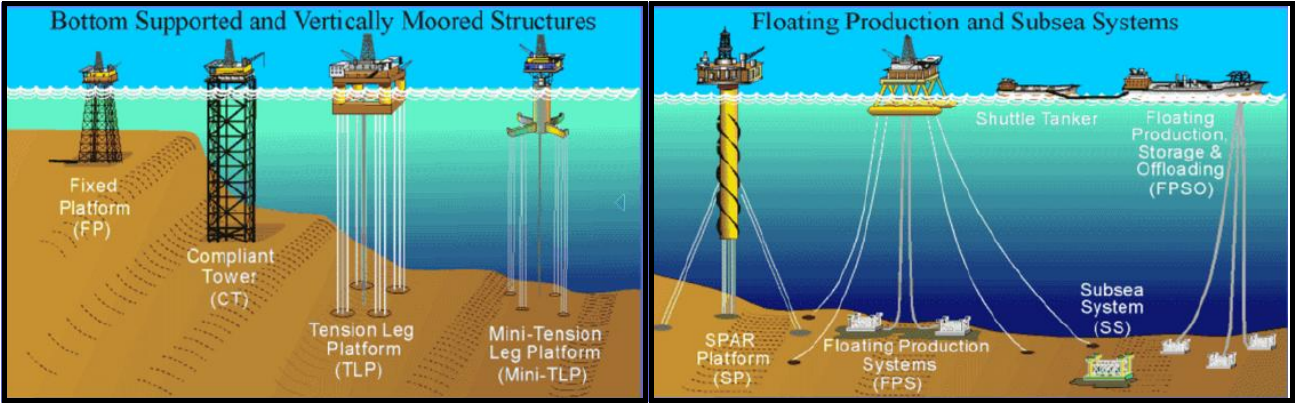
Figure 1 Marine Mooring System
2. Service Content
For this project, the service provider shall offer the project owner services including calibration guidance for pore pressure sensors and Earth pressure sensors, design guidance for sensor installation in fixed anchors, and remote data analysis services.
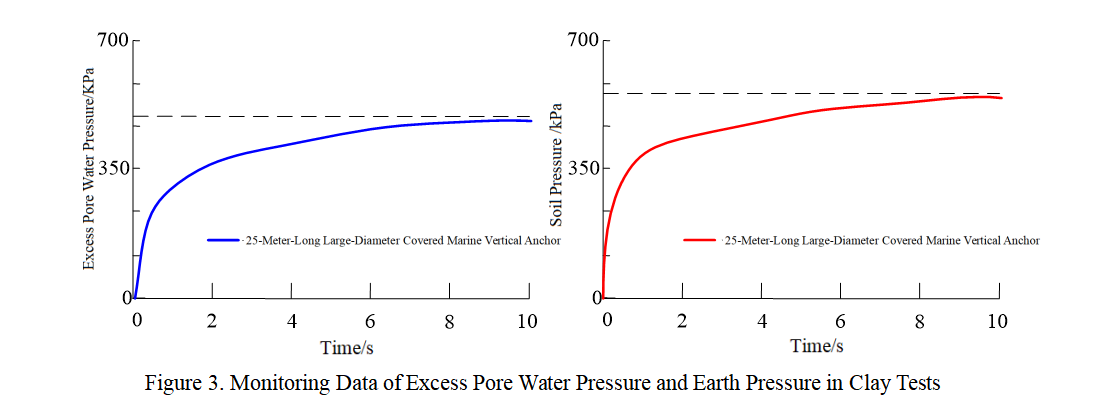
The pore pressure sensors provided for this project shall record in real time the excess pore water pressure and Earth pressure data during the tension-compression process of large-diameter suction anchors in clay and saturated sand (soil disturbance process).
The pore pressure sensors used in this project shall meet the requirements of miniaturization (diameter ≤ 10mm), be equipped with mounting threads, withstand high centrifugal acceleration of ≥ 200g, have a resolution of ≤ 0.005kPa (for recording changes in pore water pressure in soil), and a measuring range of ≥ 1MPa. The Earth pressure sensors shall meet the requirements of miniaturization (diameter ≤ 12mm), withstand high centrifugal acceleration of ≥ 200g, and have a resolution of ≤ 0.10kPa. More importantly, both the pore pressure sensors and earth pressure sensors shall be adaptable to the seawater environment (wave loads, typhoon loads).
This project requires the failure rate of pore pressure sensors to be ≤ 5%, the failure rate of earth pressure sensors to be ≤ 10%, and the working condition duration to be ≥ 30 days.
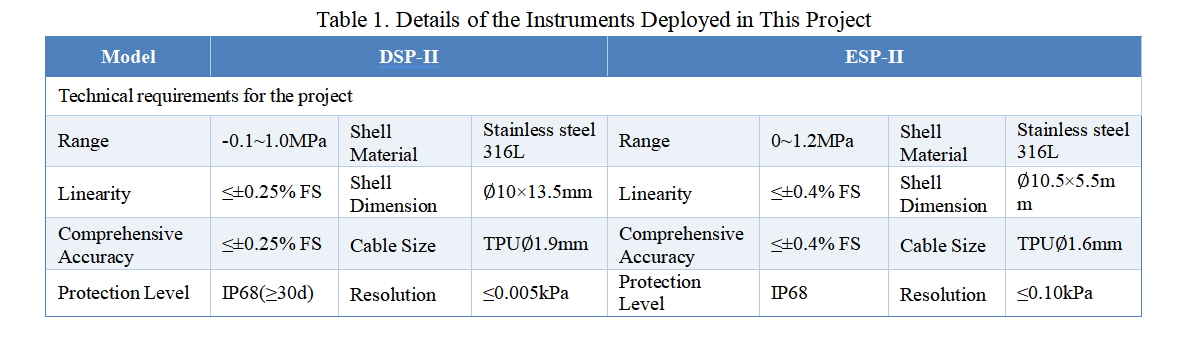
The instrument models provided for this project are DSP-II pore pressure sensors and ESP-II earth pressure sensors, with key parameters shown in Table 1.
3. Project Status and Representative Data
(1) Test Equipment
This centrifugal test adopts the DC-2200 drum-type centrifuge system, with the following specifications: maximum capacity of 600g-t, maximum centrifugal acceleration of 200g, and maximum load of 3000kg under 200g (with a maximum product of g×load of 600,000g·kg). The system is equipped with double drum grooves. The large drum groove has an outer diameter of 2.2m (the largest in the world) and an inner diameter of 1.1m, which can hold 3 tons of soil. Under the working condition of maximum acceleration (200g), it can simulate a geotechnical model with a length of approximately 1000m, a height of 80m, and a width of 140m. The width of the small drum groove is 0.3m.
(2) Test Materials
Soft clay from a region in East China is used as the test soil, with a specific gravity of 2.7 and an internal friction angle of 32°. For the sand, standard medium-fine sand from Fujian is adopted, with a particle size distribution of 0.06~0.4mm, a specific gravity of 2.65, and an internal friction angle of 33.7°.
(3) Sensor Calibration and Physical Model Diagrams
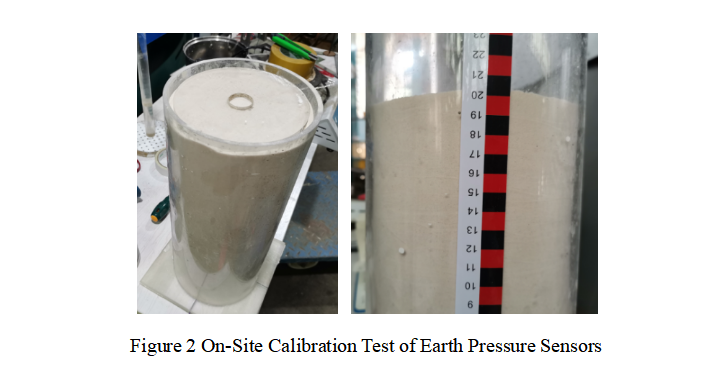
The on-site calibration test of the Earth pressure sensors is shown in Figure 2.
(4) Partial Test Results
4. Service Evaluation
The centrifugal test on the tension and compression of the offshore marine vertical suction anchor foundation lasted 90 days. During this period, our technical personnel provided remote technical services including sensor calibration guidance, fault diagnosis, data acquisition instrument debugging, and data processing and analysis. More importantly, the data recorded by the DSP-II pore pressure sensors and ESP-II earth pressure sensors has provided crucial information for the stability and wind-wave resistance of marine and port engineering structures.
User Evaluation: The DSP-II pore pressure sensors and ESP-II Earth pressure sensors exhibit excellent stability and a long service life, and can be well adapted to complex marine engineering environments (high centrifugal acceleration, cyclic loading, and seawater corrosion).
References:
[1] Chakrabarti S. Handbook of Offshore Engineering[M]. 2005.
[2] http://www.gomr.mms.gov/

 Customer Service QQ